
Why “Fine” is Not Fine

This dog’s squinted eyes, tongue licking lips, and face turned away from the camera indicate he’s not “fine.”
Our dogs are always communicating. Do you know how to listen?
Something I often hear from my dog behavior and training clients is “My dog is fine with ____” (being picked up, nail trims, our toddler, the groomer…the list is endless). As a certified professional dog trainer (CPDT-KA), and behavior consultant, I’m always observing your dog’s body language and communication signals. There is a wide range of body language signals that I often see that indicate to me that the dogs are not actually fine with whatever that event or thing is…they just haven’t escalated their communication signals, or “raised their voice” to tell you that they do not want you to continue with what you are doing.
Let’s take a look at how behavior escalates using a human analogy.
If I had a bowl of ice cream and a friend came and took the bowl away for the first time, I might just ask them for my bowl back. The next time I was eating ice cream, and they approached me, I might tense up and tell them not to touch my bowl. If they didn’t listen and still took my bowl, the next time they approach me while I am eating ice cream, I probably would walk away or tell them more firmly not to touch my ice cream. My communication signals would escalate because the person was not listening. But was I ever “fine” with them taking my ice cream? Heck. No.
Escalating Communication
When a whisper becomes yelling.
Our dogs escalate their communication the same way when their guardians disregard early communication signals.
A dog might lower their head and freeze when you approach them while they enjoy a valuable resource, then they might bite if you keep approaching.
A dog might flinch or try to move away if a groomer or vet handles a body part that is painful, or has been painful in the past (pain is a common reason that dogs display aggressive behavior, but that’s a whole different blog). If the groomer or vet doesn’t heed their warning, they might growl, snap, or bite.
A dog might be avoidant if you walk towards them to pick them up. They may snap and bite with contact if you continue to pursue them.
In all of the examples above, the dogs were not “fine” until they bit; the humans just did not know how to read the lower levels of communication signals indicating just how not fine they were.
Dogs rarely bite “out of the blue.” Usually, the case is humans miss subtle body language cues that the dog is using to say “excuse me, I’m not comfortable with ____” And when the humans miss those signals repeatedly, dogs will escalate to more intense communication signals. In behavior modification, we call that “climbing the ladder of aggression.”
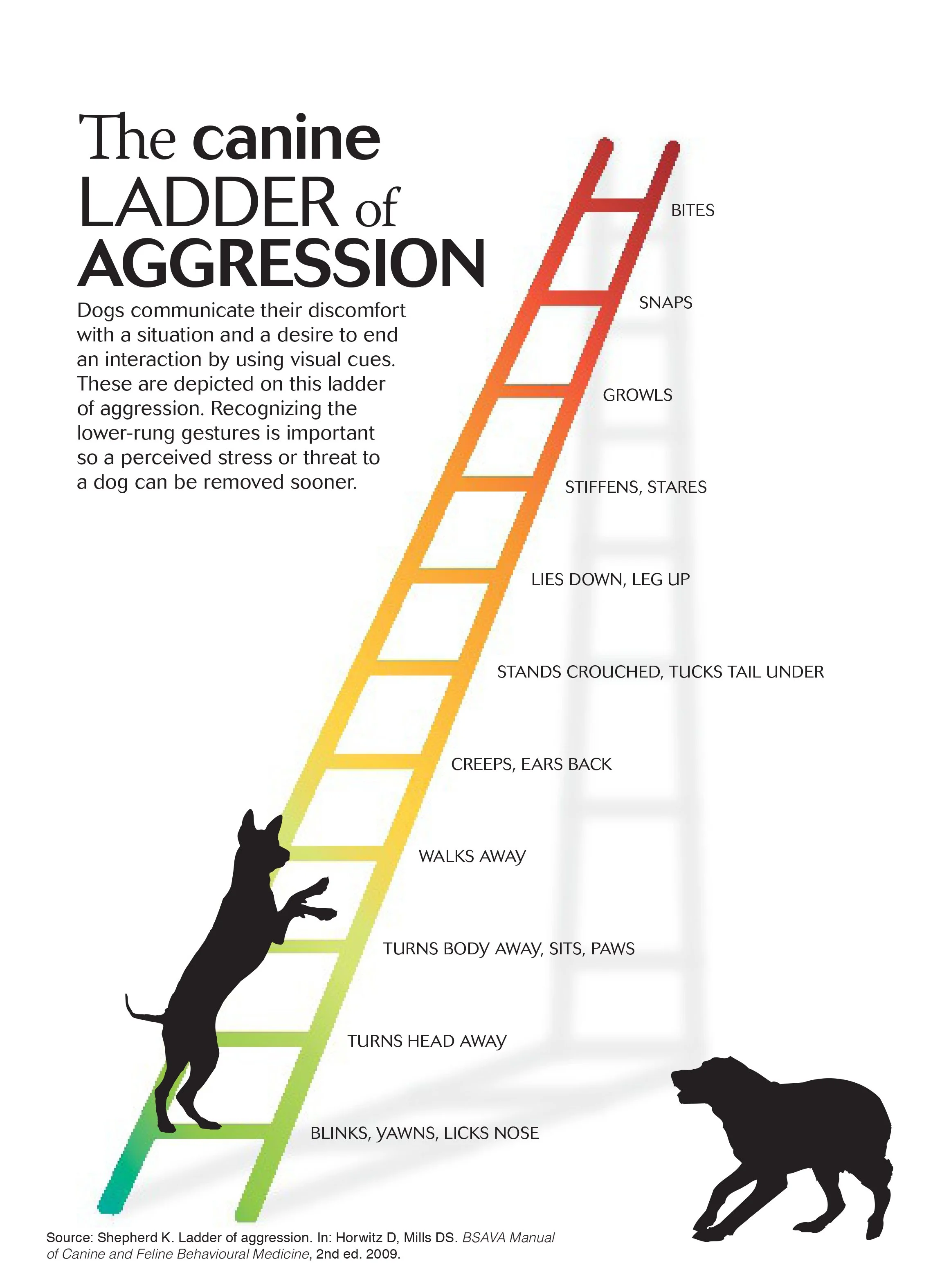
The ladder of aggression illustrates this escalation of behavior:
Blinks, yawns, licks nose
Turns head away
Turns body away, sits, paws
Walks away
Creeps, ears back
Stands crouched, tucks tail under
Lies down, leg up
Stiffens, stares
Growls
Snaps
Bites
The dog was not “fine” as soon as they began to show early signs of stress, such as blinking, yawning, and licking their nose but since the dog did not growl, snap, or bite, it’s often said “they are fine.”
It’s incredibly important to note that some dogs might skip some of these steps, especially if the communication signals have been punished in the past. Please do not punish your dog’s growl. It’s like removing the batteries from a smoke alarm… you could end up with a dog who bites with little to no warning.
How do you avoid escalation?
The first step in helping a dog from climbing the ladder of aggression is to recognize early communication signals and stop whatever is happening (or remove your dog from the situation) that caused your dog to communicate those signals.
The second step is working with a qualified trainer, behavior consultant, or veterinary behaviorist to help turn “fine” into “great” through fear free training and behavior modification.
Learned Helplessness
“Fine” or shut down?
It’s very common for clients to indicate to me that their dogs are “fine” at the groomer or vet, when in fact, their dogs have learned to be helpless. Learned helplessness happens when your dog figures out that there is nothing they can do to escape a frightening situation, and they shut down instead of fighting the situation. The result may appear to be a dog who is “fine” in these situations, when they are behaviorally shut down and still experiencing quite a bit of stress.
Finding a Fear Free certified veterinarian and groomer is a great first step in helping your dog go from “fine” to “great” when it comes to vet care and grooming. Here is a link to the Fear Free professional search.
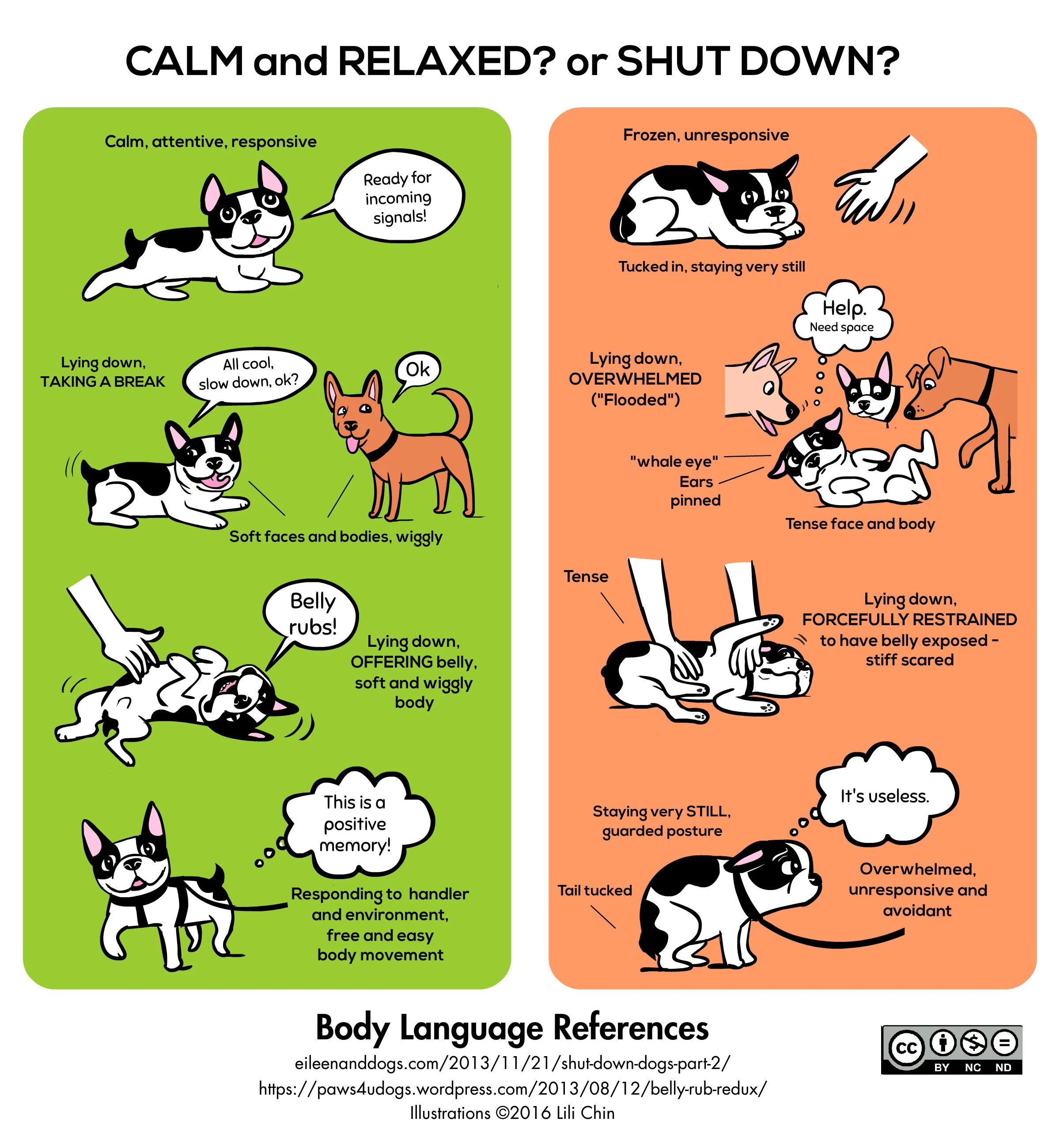
Image courtesy of Lili Chin
Reducing Stress
Stress is cumulative. Behavioral professionals often refer to accumulating stress as “trigger stacking.”
Let’s take a look at how stress accumulates using a human example.
Liz began her day by oversleeping. Then, she got cut off in traffic while driving to work. She misses her meeting and has a bunch of emails. She spends the rest of the day catching up on work… then she drives home in heavy traffic. She arrives home, hoping for a snack, and finds that her favorite snacks are gone. Normally, that wouldn’t cause a big reaction in Liz, but since she’s had quite a few stressors throughout the day, finding her snacks gone really upsets her.
Sound familiar? At this point, my clients are usually shaking their heads, “yep…”
None of the things that happened to Liz in the example above are great, but they are probably things we would consider “fine.” When combined, they lead to “not fine!”
Stress reduction is key to any behavior modification plan. It’s important to identify all sources of stress for your dog and work with a professional to properly manage or modify them. While some stressors may not seem directly related to your primary complaint (you might be wondering, “how does grooming stress relate to leash reactivity?!”), they are all contributing factors to your dog’s ability to cope with a given situation, as seen in the example above.
Working with a qualified professional can help turn these “fine” moments (which are stressors) into “great!” moments.
Getting Help
Turning “fine” into “great!” through behavior modification.
Our dogs try to avoid conflict to the best of their abilities. As humans, it’s our job to recognize the early signals in communication so that our dogs don’t have to escalate to “louder” signals such as growling, snapping, and biting. Become a better reader of your dog’s body language signals by checking out the resources at the end of this blog.
If your dog is escalating their communication, contact me to schedule a behavior consultation so we can create a custom behavior modification plan to turn “fine” into “great!”